
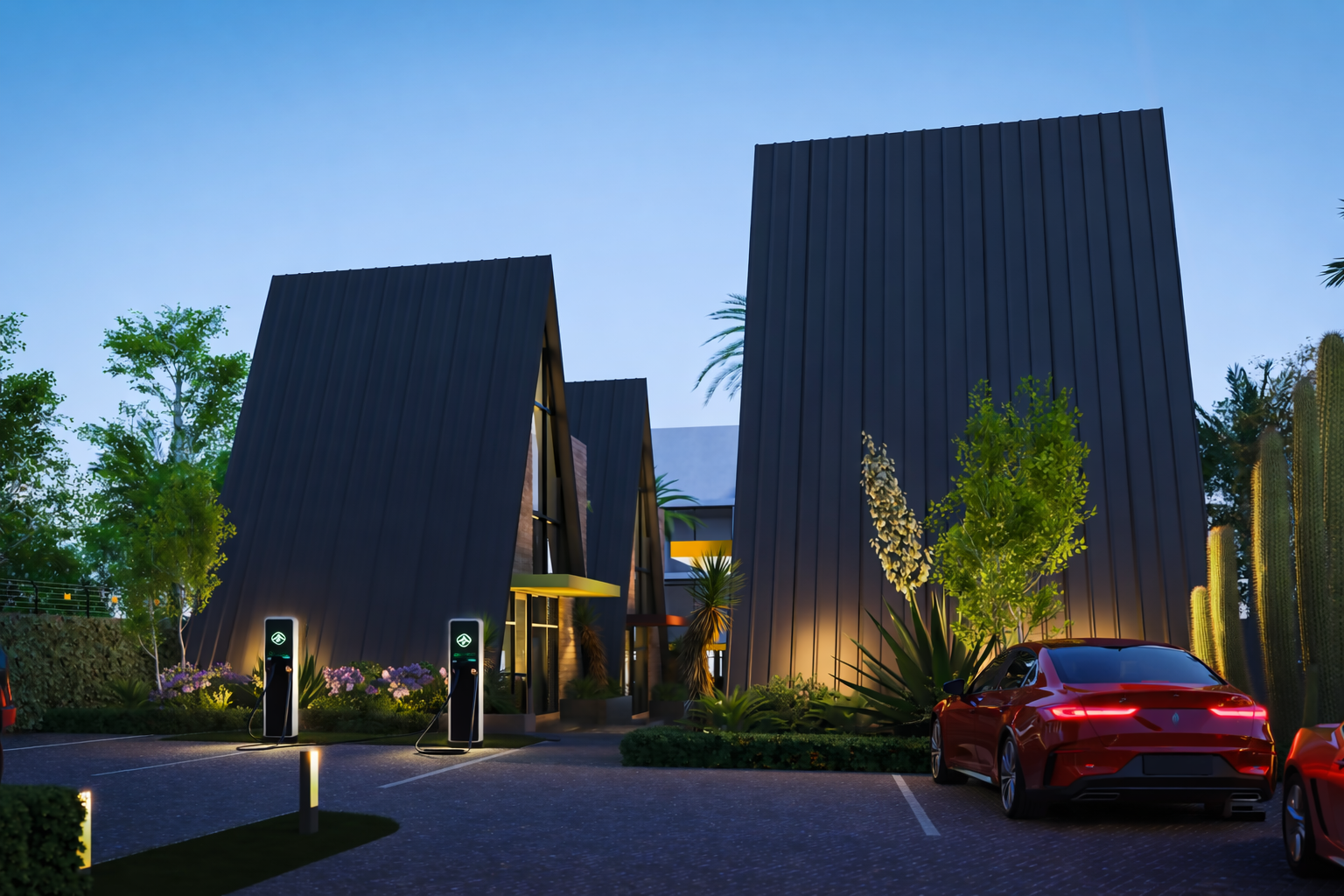
The definition of “premium real estate” is changing.
It’s no longer just about marble countertops, prime locations, or impressive façades. Forward-thinking developers are quietly shifting toward something far more strategic: energy independence and future-ready infrastructure.
Two features now separating long-term assets from outdated inventory?
Solar integration and EV charging capability.
Energy Is the New Luxury
Across emerging and developed markets alike, energy reliability is becoming a major concern. Rising utility costs and grid instability are pushing buyers to think beyond aesthetics.
A property with integrated solar systems offers:
Lower long-term operating costs
Greater resilience during power disruptions
Increased buyer demand
Stronger resale positioning
Energy-efficient homes are no longer a niche preference — they are becoming a competitive advantage.
EV Adoption Is Accelerating — Infrastructure Must Follow
Electric vehicles are steadily entering global and African markets. Yet most residential properties remain unprepared.
Developments that integrate EV charging infrastructure early gain a structural advantage:
Future-proofed parking and electrical systems
Appeal to higher-income, forward-thinking buyers
Avoidance of costly retrofitting
Stronger differentiation in competitive markets
Ignoring EV infrastructure today is similar to ignoring broadband wiring 20 years ago.
Sustainability Is Becoming a Capital Strategy
Institutional investors, diaspora buyers, and next-generation homeowners increasingly evaluate environmental resilience alongside returns.
Solar integration and EV readiness:
Improve asset durability
Strengthen rental demand
Enhance ESG positioning
Support long-term capital appreciation
This is not just environmental positioning. It is strategic risk mitigation.
For Smart Investors: The ROI Case
Let’s move beyond ideology and look at numbers.
When underwriting a development, energy-integrated assets influence core financial metrics:
1. Net Operating Income (NOI) Expansion
Lower energy costs improve tenant affordability and retention, supporting higher occupancy rates and rental stability — directly strengthening NOI.
2. Cap Rate Compression
Assets with resilient infrastructure and strong ESG positioning often trade at tighter cap rates due to perceived lower risk and future-readiness. Even modest cap rate compression can significantly increase exit valuation.
3. Internal Rate of Return (IRR) Enhancement
Energy cost savings, rental premiums, and stronger exit multiples compound over the hold period, increasing overall IRR.
4. Operating Expense (OPEX) Reduction
Solar reduces reliance on grid electricity, lowering service costs and buffering against energy price volatility — protecting cash flow consistency.
5. Future Retrofit Cost Avoidance
Integrating EV infrastructure during construction is materially cheaper than retrofitting later. Early integration protects development margins.
In simple modeling terms:
Lower OPEX
Higher demand
Greater asset resilience
Stronger exit valuation
= Superior risk-adjusted returns.
The Long View
Real estate is a long-duration asset class. The question isn’t what buyers want today — it’s what they will require 10–20 years from now.
Smart developers are not adding solar and EV infrastructure as marketing features.
They are engineering defensible value.
The future of premium real estate will not just be beautifully designed.
It will be intelligently powered — and intelligently underwritten.